DataMatrix code and traceability
Permanent component marking for seamless traceability in industrial manufacturing processes
A DataMatrix code enables the unique identification of components and forms the basis for end-to-end traceability in industrial manufacturing processes. Each workpiece is given a unique identifier that reliably links production data, quality information and serial numbers to the respective component. This makes it possible to document manufacturing processes, trace products throughout their entire life cycle and meet statutory or industry-specific requirements.
However, reliable traceability is not achieved simply by applying a DataMatrix code. The key lies in the interplay between a permanently legible marking, a quality assessment that complies with standards, and a reading technology that ensures process reliability. Only when these components are coordinated with one another can a component remain uniquely identifiable throughout the entire production process and often for many years beyond.
We at Borries Markier-Systeme GmbH have been developing marking systems for industrial direct marking since 1952 and support companies in implementing end-to-end traceability solutions. In doing so, we consider the entire marking process – from marking and verification through to the reliable identification of markings such as DataMatrix codes.
What is a DataMatrix code?
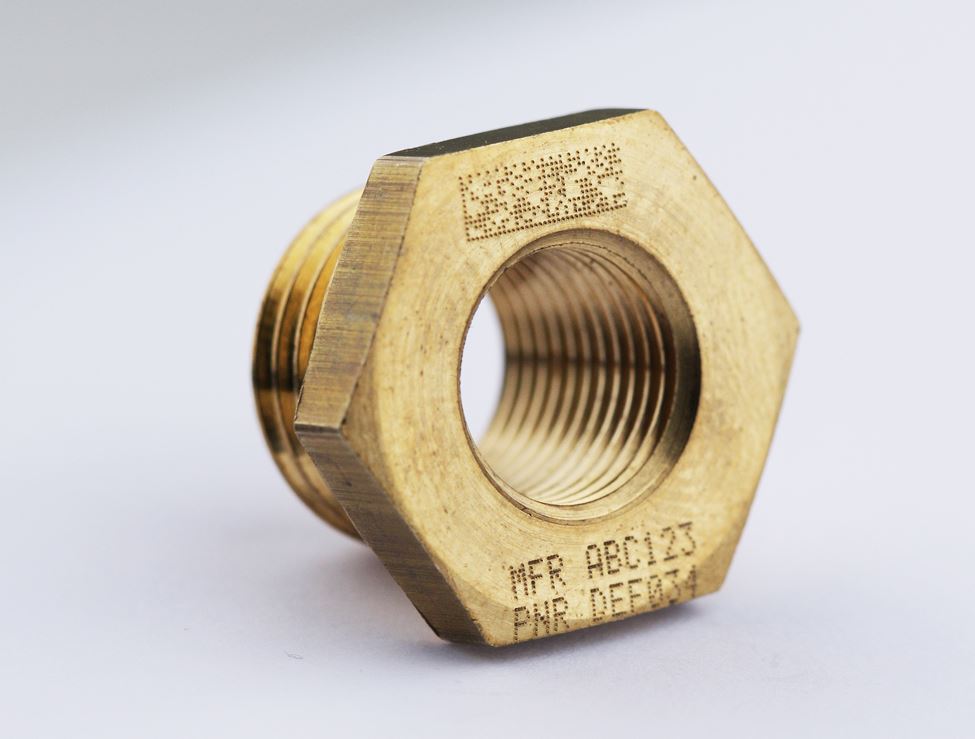
A DataMatrix code is a two-dimensional code (2D code) that stores information within a very small area and is used to uniquely identify components. Due to its high information density, it is particularly suitable for industrial direct marking, where components are permanently marked and automatically identified. Depending on the application, it can store various types of information or act as a unique key to reference data records in higher-level IT systems. It thus forms the basis for end-to-end traceability throughout the entire product lifecycle.
Unlike one-dimensional barcodes, a DataMatrix code can store significantly more information. It consists of a square or rectangular matrix of light and dark cells, or permanently applied marking points. The encoded data can be captured quickly and reliably using stationary or handheld scanning systems.
In industrial manufacturing, the DataMatrix code often does not contain all product information. In most cases, it merely stores a unique identification number that is linked to production, quality or service data in a higher-level ERP, MES or traceability system. This allows large volumes of data to be managed without unnecessarily increasing the size of the code.
What does traceability mean?
Traceability refers to the ability to clearly track the entire life cycle of a component or product. From manufacture through to processing and quality assurance, right through to maintenance, servicing or recycling, all relevant information can be linked to an individual workpiece.
In modern manufacturing processes, traceability is an essential component of quality assurance. It creates transparency throughout the entire production process and makes it possible to uniquely identify components at any time. This allows production data, material batches, test results or process parameters to be reliably documented and assigned to an individual workpiece.
The basis for this is a unique identification of the component, for example using a DataMatrix code. This identification allows information from ERP, MES or other traceability systems to be linked to the physical workpiece. The DataMatrix code serves as the component’s unique identifier and connects the physical production process with the digital documentation.
Traceability helps companies to identify quality deviations more quickly, analyse causes efficiently and implement targeted measures. At the same time, it facilitates compliance with legal and industry-specific requirements and helps to limit product recalls to only those components that are actually affected.
However, reliable traceability does not end with the application of a DataMatrix code. Only when marking, verification and reading technology are viewed as an integrated process does a permanently secure and cost-effective solution for industrial traceability emerge.
Why is traceability essential today?
Requirements regarding quality, documentation and product safety are constantly rising. At the same time, manufacturing processes are becoming increasingly digitised and internationally networked. Companies must therefore be able to demonstrate at any time when a component was produced, which materials were used, which processing steps were carried out and which quality checks were performed.
End-to-end traceability provides the necessary transparency for this and forms the basis for:
- seamless traceability of components and products
- documented quality assurance
- targeted analysis of complaints and root causes
- efficient product recalls
- compliance with statutory and industry-specific requirements
- digital production and logistics processes
- long-term documentation across the entire product life cycle
Traceability is therefore far more than just a legal requirement today. It is a central component of modern manufacturing and quality processes and helps companies to manufacture products safely, efficiently and in a traceable manner.
How is reliable traceability achieved?
A permanently legible DataMatrix code alone does not guarantee reliable traceability. It is only the combination of marking, verification and reading technology that enables reliable traceability throughout the entire product life cycle.
In industrial manufacturing, a component must do more than simply be uniquely marked. It is equally important that the DataMatrix code is verified immediately after marking and can subsequently be reliably read under real production and operational conditions. Even minor deviations in marking or unfavourable reading conditions can compromise the quality of traceability.
End-to-end traceability is therefore based on three coordinated process steps:
- Marking
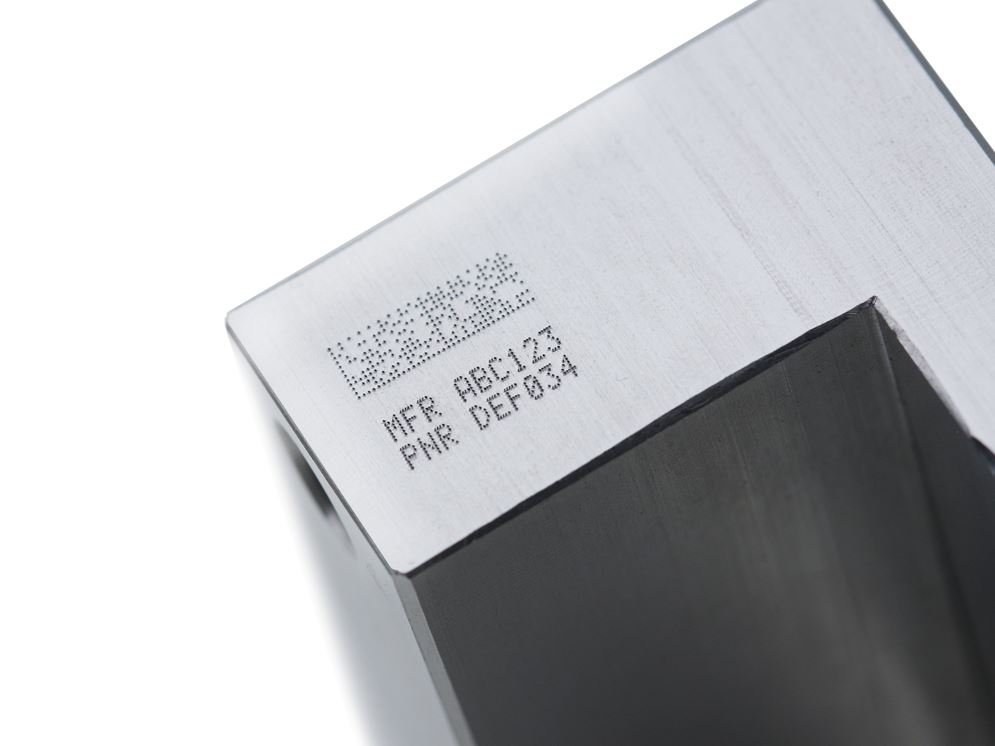
The DataMatrix code is permanently applied directly to the component. This form of direct component marking is known internationally as Direct Part Marking (DPM). The aim is to create a permanently legible marking that meets the requirements of the respective material, the component geometry and the subsequent operating conditions. - Verification
Once the marking has been applied, the quality of the DataMatrix code is assessed. This involves checking not only whether the code is currently readable, but also whether it meets defined quality criteria and can be read reliably over the long term. Verification helps to identify process deviations at an early stage and ensure a consistently high standard of marking quality. - Reading technology
Throughout the rest of the manufacturing process and across the entire product life cycle, it must be possible to reliably identify the DataMatrix code under a variety of conditions. Lighting, surface texture, contamination or mechanical stress can affect readability and should be taken into account when planning a traceability solution.
Only when marking, verification and reading technology are viewed as an integrated process can truly reliable and cost-effective traceability be achieved.