Type wheel marking technology for industrial direct marking
Type wheel marking technology is a mechanical marking process for the permanent marking of workpieces with variable alphanumeric content and freely definable special characters. The process works like a ‘typewriter on metal’, as individual characters are selected sequentially and precisely imprinted into the material. It is used in industrial production environments where deep markings, high process speeds and reproducible quality are required.
Unlike superficial marking methods, type-wheel marking creates a plastic deformation of the material, ensuring that the marking remains permanent even under mechanical stress, corrosion or thermal stress. Typical materials include steel, stainless steel, aluminium, cast iron and engineering plastics.
The technology is particularly suitable for applications involving:
safety-related marking
legal traceability
high volumes and short cycle times
variable data (e.g. serial numbers, FIN/VIN)
Applications of type wheel marking technology
Type-wheel marking technology is used wherever durable, mechanically resilient markings are required directly on the material. Typical applications include industrial mass production, automotive applications and the manufacture of nameplates.
VIN marking
The chassis number (Vehicle Identification Number = VIN) is a globally unique identification number for vehicles. It is stamped directly onto load-bearing parts of the vehicle, usually the bodywork.
Type wheel marking technology is one of several methods used to mark the vehicle identification number (VIN). It is the preferred choice when particularly deep marks, the processing of high-strength steels and integration into automated manufacturing processes are required. The Type 123 type wheel marking machine achieves marking depths of up to 484.4 µm, for example to mark truck chassis permanently and reliably.
In practice, this means:
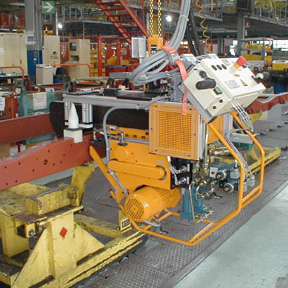
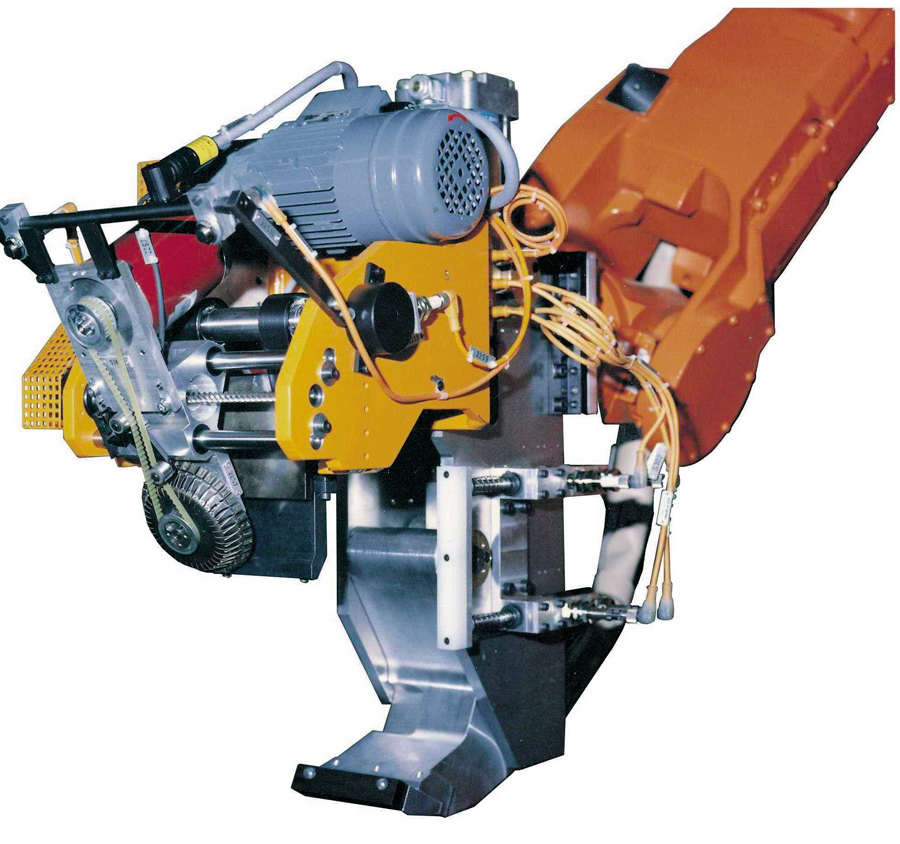
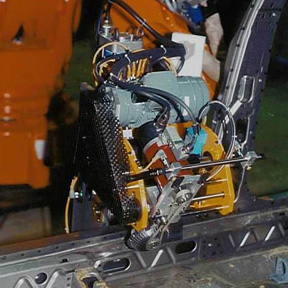
The marking machine can be guided manually via a handling system or mounted directly on a robot.
Marking takes place directly in line with the production cycle.
Each number is clearly and permanently marked on the component.
Even after painting or coating, the marking remains clearly visible and meets legal requirements for traceability.
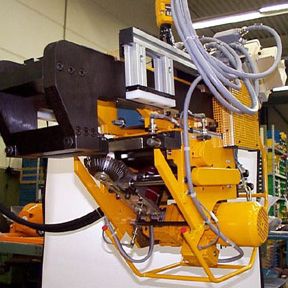
Type wheel marking system for VIN marking on lorry chassis
The type wheel marking mechanism permanently marks individual characters onto the component using a type wheel and is used for VIN markings.
Process: Type wheel marking
Marking: numbers, letters, special characters
Type wheel: 39 to 96 interchangeable individual characters
Noise level: approx. 75 dB(A)
Application: manual or automated (e.g. robot integration)
Features: eccentric mechanism for uniform marking force, hydraulic clamping device for secure component fixation
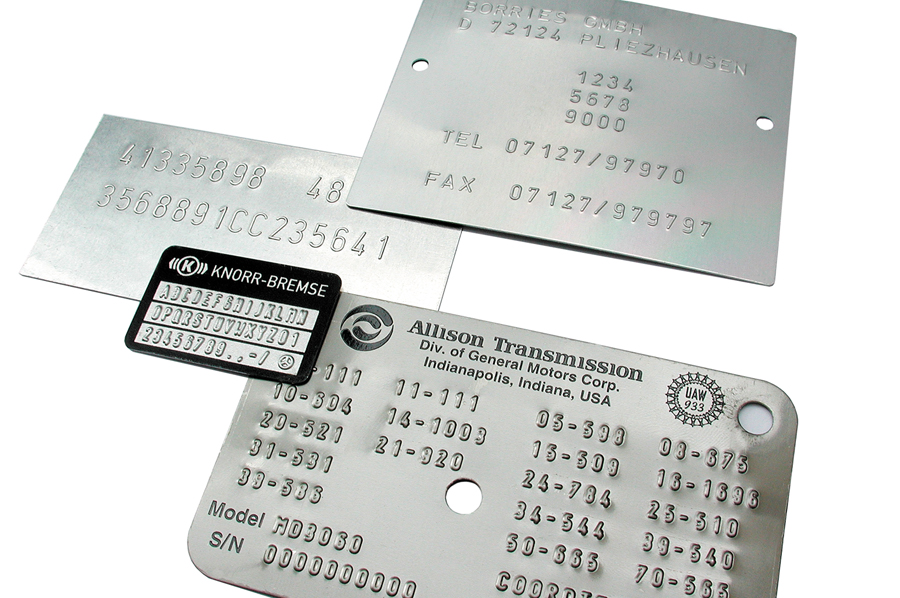
Relief nameplates
Nameplates are components used to identify machinery, equipment or products. They contain information such as the manufacturer, serial number, batch number or technical specifications.
In relief marking, these elements are raised from the surface of the material. This means that the text stands out visibly above the surface and remains legible even under heavy wear and tear.
Typical production process:
- Blank nameplates are automatically taken from a magazine,
- The variable data (such as serial numbers) is marked,
- Finished nameplates are sorted and stored.
This form of marking is used for three reasons. When:
- High resistance to abrasion is required,
- Plates are to be painted or coated,
- Long-term legibility must be ensured.
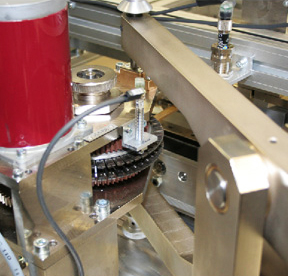
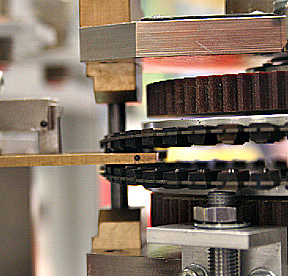
Marking of series components
Type-wheel marking technology is used in industrial series production for the permanent marking of various components. The process is particularly suitable for components that are subject to mechanical stress and need to be permanently identifiable.
Typical components include, for example:
Vehicle bodies,
Steel beams and structural components,
Safety-critical fasteners
These components are marked directly onto the material, ensuring that the marking:
Remains permanently legible,
Cannot be removed,
Is unaffected by paintwork or dirt.
Typical marking content includes:
Serial numbers
Batch numbers
Manufacturer markings
Inspection codes or internal traceability data
Thanks to the combination of high marking speed and variable data, type wheel marking technology is particularly well suited to applications involving high volumes and clearly defined marking requirements.
How type wheel marking technology works
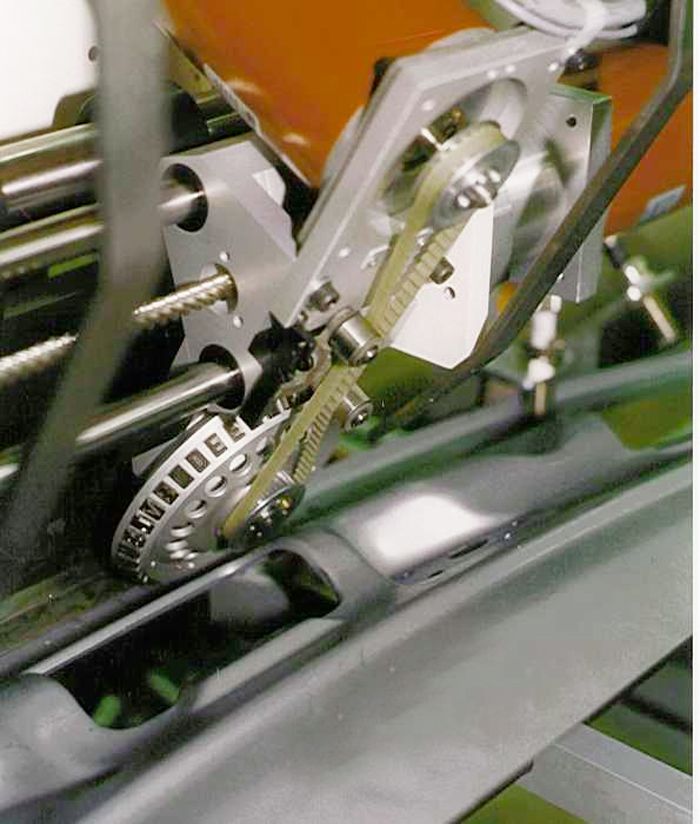
The central component is a rotating type wheel containing between 39 and 96 characters. The individual characters are precisely positioned by a stepper motor and then mechanically stamped into the workpiece.
Mechanical marking process
The marking process is carried out in defined individual steps:
Selection and positioning of the character on the type wheel
Linear movement in the X-direction to position the character
Triggering of the marking stroke via an eccentric mechanism
Force transmission to the workpiece with a defined marking depth
Each character is marked in a single stroke. This ensures consistent character geometry and a constant depth of marking.
Drive and control
The motion sequences are achieved through several synchronised components:
Stepper motors for type wheel positioning and feed
Geared brake motor for continuous movement of the eccentric
Sensors for enabling and position monitoring
An electronic marking controller processes the marking data and controls the entire sequence. In doing so, ASCII data can be imported directly and converted into specific movement sequences.
System architecture and components
A type wheel marking system consists of several functional units designed to withstand continuous industrial use.
Type wheel marking mechanism
The marking mechanism comprises:
A type wheel with interchangeable characters
A cross slide for movement along the X-axis
An eccentric mechanism for the marking stroke
A hydraulic clamping device with an integrated anvil
The anvil stabilises the marking zone and ensures that the applied force is fully transferred into material deformation. The marking depth is defined by mechanical stops and can be adjusted to ensure reproducibility.
Marking Controller
The controller handles all aspects of process control:
Processing of variable marking data
Control of axis movement and marking parameters
Scaling of font sizes
Integration into higher-level control systems (e.g. PLC via Profibus)
In addition, a macro programme enables customisation to meet specific customer requirements, as well as the management of layouts and marking content.
Periphery and Integration
The overall system contains:
Operating console or control panel
Hydraulic unit for clamping device
Control cabinet with electrical components
Adapter for workpiece-specific clamping
These components enable both manual and automated applications.